
What AI Still Can’t See in Your Home

October 23, 2026
Not long ago, creating a convincing vision of a room took time.
There were sketches, references, samples, revisions, conversations. An idea had to be worked through before it could be seen.
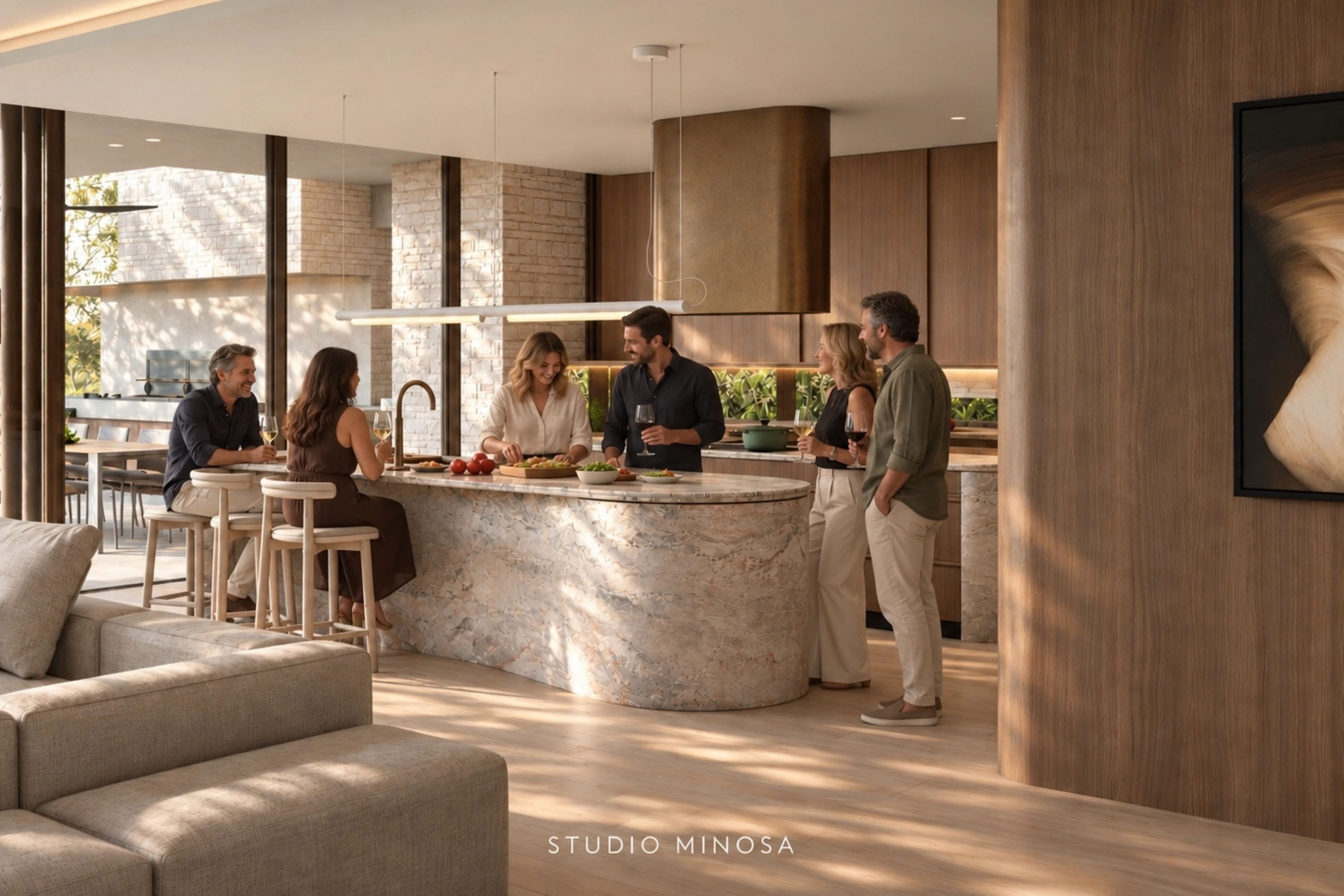
Now, you can type a few words into a screen and watch a room appear almost instantly.

Change the stone. Make the cabinetry darker. Soften the light. Remove the island. Add another. Within minutes, you can move through a dozen versions of a space that does not yet exist.
It is hard not to be impressed.
It is also hard not to feel a little uneasy.
For designers, there is an obvious question hiding inside that speed: if the image becomes easy, what happens to the value of the person who once made it?
But the more interesting answer appears when you step away from the screen and back into a real home.
A client might tell us they need more storage. That seems simple enough. Until you spend time with them and realise the issue is not storage at all. It is the school bags dumped near the kitchen, the shoes that migrate through the hallway, the paperwork that has no natural home, the bench that becomes a landing zone for everything.

The problem was never a cupboard. It was the way life was moving through the house.
Another client may arrive with an image of a beautiful open kitchen. They love the sense of space, the simplicity, the calm. Yet during conversation it becomes clear they cannot stand seeing a toaster, a coffee machine or a stack of plates left out.
Suddenly the brief changes, not because the image was wrong, but because the image never told the whole story.
This is where residential design has always been more complicated than it looks. People rarely arrive with a perfectly formed understanding of how they want to live. They bring fragments, references, habits, frustrations and contradictions, and the designer’s role is to make sense of all of it.
That is also why AI is both confronting and exciting.
It is becoming extraordinarily good at producing possibility. It can help us explore faster, visualise earlier and test directions that once would have taken much longer to develop. Used well, that does not diminish the design process. It opens it up.
But a home does not improve simply because more options exist. At some point those options have to be weighed against one another, and that is where judgement starts to matter more, not less.

A wall can move easily on screen, but in reality that decision can change circulation, light, privacy, joinery, structure and the way two rooms relate. A larger opening may create openness but remove intimacy. More cabinetry may solve storage while making a room feel heavier. A striking material may look perfect in an image but feel completely wrong once it is seen in the changing light of the actual space.
And then the project is built.
This is where design becomes physical and begins to resist the certainty of the render. Stone arrives slightly warmer than expected. Afternoon light alters a colour. A junction that appeared delicate becomes too dominant at full scale. Something hidden inside a wall changes the conversation entirely.
The house begins to give you new information.
The best projects are rarely the ones that follow the original image without question. They are the ones where the idea is strong enough to survive change, but flexible enough to improve when reality reveals something the drawings could not.
Sometimes that means holding firmly to the original intent. At other times it means letting an idea go because the space is telling you there is a better answer.
This is where experience sits. Not in having more ideas, but in knowing which ones to keep.
Perhaps that is the most interesting thing AI is doing to design. It is making the generation of images faster, easier and more democratic, while quietly shifting the value elsewhere.
The value begins to sit in interpretation. In editing. In understanding the people who will live there and recognising the difference between something that looks convincing and something that genuinely feels right.
That is the part that should make us excited.
AI can give us more ways to imagine a home.
But the real work still lies in understanding the life inside it.

Design Life Better
Do you have an exciting new project? Click below to learn more!
Stalk us


